
How do schools decide snow days? In short, a superintendent weighs safety reports before dawn and makes one call for the whole district.
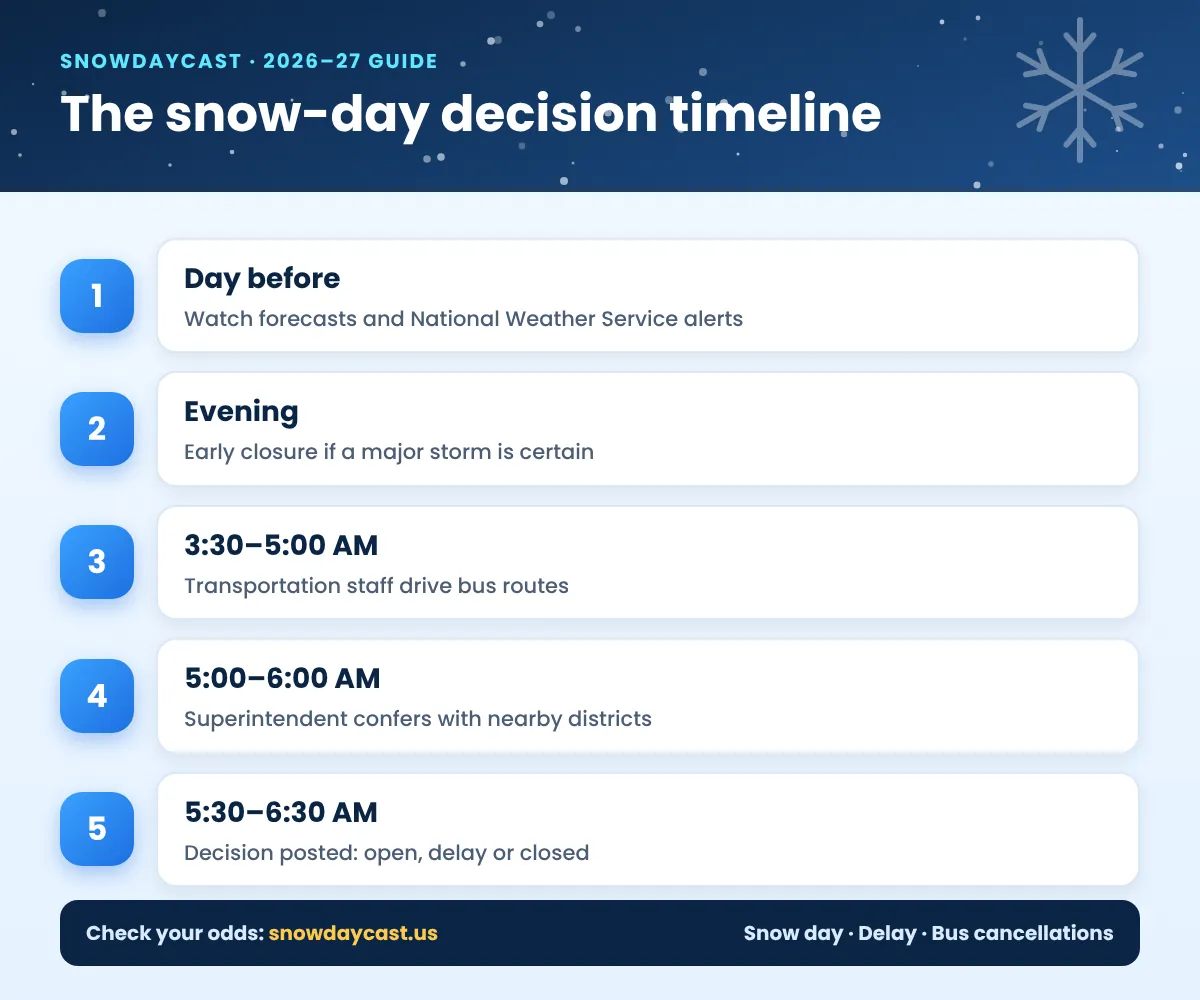
In most districts the superintendent makes the call, usually between 4:30 and 6:30 AM, after transportation staff drive bus routes, check forecasts and National Weather Service alerts, and talk with neighboring districts. The question is simple: can buses, walkers and staff get there safely?
Key takeaways
- The decision is about safe travel, not snow totals.
- Road checks often start around 3:30–5 AM.
- Districts coordinate with neighbors and bus companies.
- Canadian boards often cancel buses but keep schools open.
Who makes the call
In the US, the superintendent (or an assistant superintendent) is usually responsible. They rely on the transportation director, who knows which roads and hills cause trouble, and on facilities staff who make sure buildings have heat, power and cleared lots. In Canada, decisions are made by the school board or centre de services scolaire, and student transportation consortia often cancel buses on their own.
What they check
| Factor | What they look for |
|---|---|
| Forecast | Snow and ice totals, and when they arrive |
| Road conditions | Ice, drifts, plowed or not, hills and bridges |
| Temperature | Wind chill for students at bus stops |
| Alerts | Winter Storm or Ice Storm Warnings from the NWS |
| Buildings | Power, heat, cleared parking lots and walkways |
| Neighbors | What nearby districts and bus contractors plan |
The night before vs. the morning of
When forecasts are confident, such as a major storm that is already underway, districts may announce the evening before. When the timing or precipitation type is uncertain, they wait for the early-morning road check. That’s why snow-day predictions are most useful the evening before: they tell you how likely that early-morning call is.
Closed, delayed or early dismissal?
Districts have more options than “open or closed.” A two-hour delay gives road crews time to work. An early dismissal sends students home before a storm arrives. Some states allow remote learning days instead.
How to get the decision fast
- Sign up for your district’s text, email or app alerts.
- Follow the district’s official social accounts.
- Check local TV closing lists.
- Use our snow day calculator the night before to see how likely a closure is.
A sample snow-day morning, hour by hour
- 8 PM the night before: the district reviews the latest forecast and National Weather Service alerts, and may warn families that a decision will come in the morning.
- 3:30–4:30 AM: transportation staff drive hills, back roads and bus routes, and check with road crews.
- 4:30–5:15 AM: the superintendent talks with neighboring districts, city crews and bus contractors.
- 5:15–6:30 AM: the decision goes out by text, email, app, website and local TV.
- 7–8 AM: on delay days, the district checks again and may upgrade to a closure.
How do schools decide snow days when forecasts disagree?
When models disagree on timing or whether precipitation falls as snow, sleet or rain, districts usually wait for the early-morning road check rather than closing the night before. That is why snow-day predictions are most uncertain for borderline storms and most confident for big, well-forecast events. Families can follow the NWS winter safety guide to understand what each alert level means.
Why some districts close and others don’t
Neighboring districts often make different calls on the same morning. A compact city district with sidewalks and short bus routes can stay open when a rural district next door, with long routes on hilly back roads, closes. Districts with older buses, fewer drivers or many students who walk may also lean toward closing. Others have already used their built-in snow days and prefer a two-hour delay to avoid adding days in June.
The role of bus contractors and city crews
Many districts contract their buses from private companies, and those companies have their own safety rules. City and county road crews also matter: if they can’t treat roads before buses leave, closures become more likely. Superintendents often call road supervisors directly before dawn to ask which routes are passable.
What families can do
- Keep your contact details up to date with the school office.
- Learn your district’s delay and closure policies at the start of winter.
- Check the odds the night before, then wait for the official alert.
Frequently asked questions
Who decides if school is cancelled for snow?
In most US districts the superintendent makes the final call, based on input from transportation, facilities and safety staff. In Canada, school boards or school service centres decide, and bus operators often cancel buses separately.
What time are snow days announced?
Most districts announce between 5:30 and 6:30 AM. Some announce the night before when a big storm is certain.
Why did my school stay open when the next district closed?
Each district weighs its own roads, bus routes, terrain and number of days already used. Hilly or rural districts close more often than compact city districts.
Do schools get in trouble for too many snow days?
Most states require a minimum number of instructional days or hours. Extra days may be made up at the end of the year, or covered by remote-learning days where the state allows.
Keep reading
 Canada · 3 min readBus Cancellations vs. School Closures in Canada (2026–27)In much of Canada, buses are cancelled for snow, ice or extreme cold while schools stay open. Here's how it works and…
 Snow Day Fun · 4 min read40 Snow Day Activities for Kids (Indoor & Outdoor)From snow ice cream and colored snow painting to indoor forts and science experiments, here are 40 easy ways to make a…
 Snow Day Basics · 4 min readHow to Check if School Is Closed Tomorrow (Fast)Sign up for your district's alerts, check its website and social accounts, watch local TV closing lists, and use a snow day…