
School closings are announced by each district, usually between 5:30 and 6:30 AM, and the fastest way to hear is through official alerts.
The fastest way is your district’s own alerts (text, email or app), followed by its website and social media and local TV closing lists. Most decisions are posted between 5:30 and 6:30 AM. The night before, use our snow day calculator to see how likely a closure is.
Key takeaways
- Official alerts beat rumors and screenshots.
- Decisions are usually made around 5–6:30 AM.
- In Canada, check bus cancellations separately.
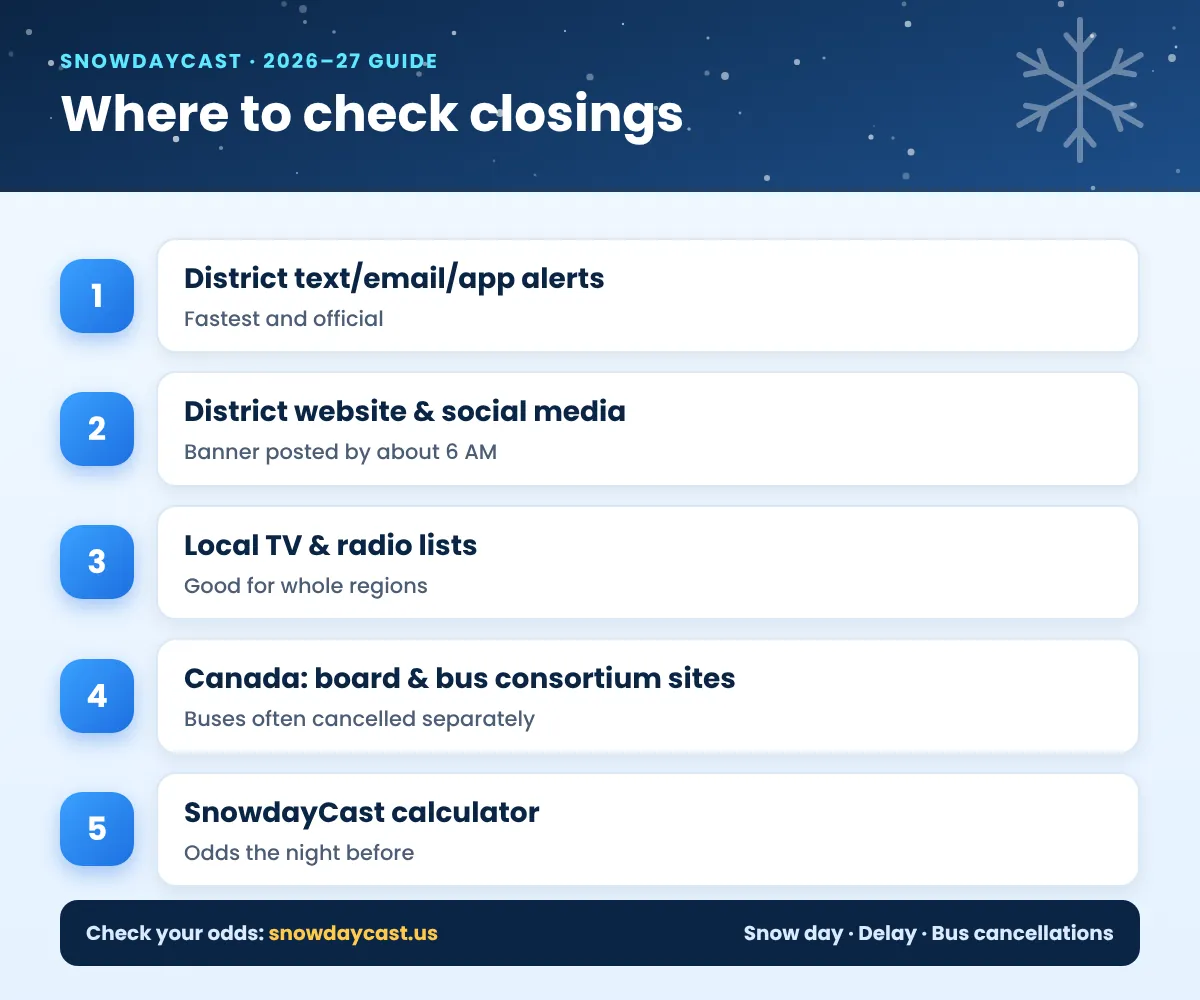
5 ways to check, from fastest to slowest
- District alerts: sign up for text, email, call or app notifications.
- District website: look for a banner at the top of the homepage.
- Social media: official district accounts often post first.
- Local news: TV and radio stations keep closing lists for the whole region.
- Bus and transportation sites: essential in Canada and rural districts.
When announcements go out
| Situation | Typical timing |
|---|---|
| Major storm already underway | Evening before |
| Overnight snow or ice | 5:00–6:30 AM |
| Delay upgraded to closure | By about 7–8 AM |
| Early dismissal | Late morning or midday |
Avoid fake closing rumors
Every winter, fake screenshots of closing notices spread on social media. Trust only your district’s official channels. Our calculator is a prediction tool, not an announcement.
School closings: where each source gets its information
Every list of school closings, whether on TV, radio or an app, comes from the districts themselves. That’s why the district’s own alerts are always first and always correct. TV and radio lists are useful when you want to see every school closing in a region at once, for example when you have kids in different districts.
School closings checklist for families
- Save your district’s website and app on your phone’s home screen.
- Turn on notifications for the district’s official social accounts.
- Know your school’s code or name on local TV closing lists.
- In Canada, bookmark your school board and transportation consortium pages.
- Check the National Weather Service forecast the night before.
Emergency closings that aren’t about snow
School closings also happen for power outages, water main breaks, extreme cold or heat, and flooding. The Ready.gov winter weather checklist helps families prepare for any winter emergency.
School closings for private and charter schools
Private, parochial and charter schools often follow the public district where they’re located, but not always. Some make their own decisions or follow a diocese. Check each school’s policy at the start of winter so you know which announcement to watch.
School closings and after-school activities
When school closes, after-school activities, sports and evening events are usually cancelled too. On delay days, morning activities are cancelled but afternoon events may still happen. On early-dismissal days, evening events are almost always cancelled. If in doubt, check with the coach or activity leader.
How we help with school closings
We don’t post official school closings, but our calculator estimates how likely a closing is the night before, so you can plan ahead. When the official announcement comes, always follow your district.
Frequently asked questions
How can I find out if school is closed tomorrow?
Sign up for your district's alerts and check its website or social media between 5:30 and 7 AM. Local TV stations also publish closing lists.
Can I know the night before?
Sometimes. Districts announce early for major storms. Otherwise, a snow day calculator gives you the odds the night before.
Where do Canadian schools post bus cancellations?
Most boards post on their websites and social media, and student transportation consortia post bus cancellations by region.
Is your calculator official?
No. Only your school district or board can close school. We estimate the chances from forecasts and alerts.
Keep reading
 Snow Day Basics · 4 min readAre Snow Days Going Away? Remote Learning Days ExplainedMany districts now switch to remote or e-learning days instead of traditional snow days, but power, internet and teacher-planning limits keep real…
 Snow Day Basics · 5 min readHow Do Schools Decide Snow Days? Inside the 5 AM CallSuperintendents usually make the snow-day call between 4:30 and 6:30 AM after checking forecasts, driving the roads and talking to transportation teams.
 Winter Travel · 5 min read12 Best National Parks to Visit in Winter (2026–27 Snow Guide)Snow-covered geysers in Yellowstone, white-capped hoodoos at Bryce Canyon, quiet Yosemite Valley: the best national parks for a winter trip and how…