

How much snow for a snow day depends on where you live, how fast the snow falls and what time it arrives.
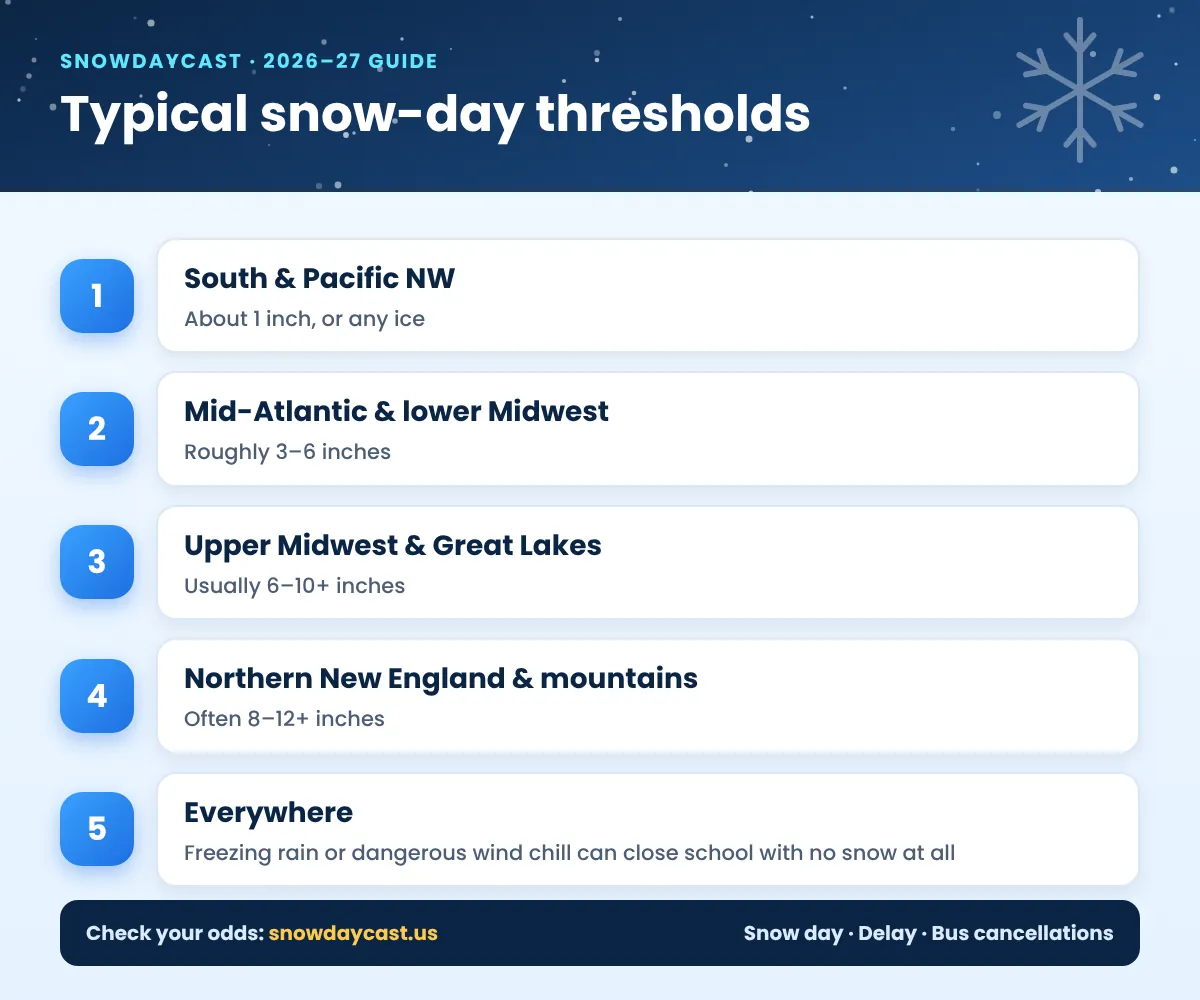
There is no single number. As a rule of thumb, about 1 inch can close schools in the South and Pacific Northwest, 3–6 inches in the mid-Atlantic and lower Midwest, and 6–12 inches or more in snow-belt states and Canada. Ice, timing and wind chill often matter more than the total.
Key takeaways
- Districts that rarely see snow close for much less of it.
- Snow falling during the morning bus run is the biggest trigger.
- Freezing rain can close schools with zero snow.
- Use our snow day calculator to see your local odds for tomorrow.
Snow-day thresholds by region
School leaders don’t look at a single snow total. They ask whether buses, walkers and staff can get to school safely at 7 AM. That depends on how many plows and how much salt the area has, how hilly and rural the roads are, and how used to snow local drivers are. That is why the same storm can close every school in Atlanta and barely slow Buffalo.
| Region | Typical closure range | What usually tips it |
|---|---|---|
| Deep South, Texas, Gulf Coast | Any accumulation, about 1 in | Ice on bridges and overpasses |
| Pacific Northwest (Seattle, Portland) | 1–2 in | Hills, few plows, freezing rain |
| Mid-Atlantic (DC, Virginia, Maryland) | 2–5 in | Morning timing, ice mix |
| Ohio Valley & lower Midwest | 3–6 in | Rural roads, wind chill |
| Great Lakes snow belts | 6–10+ in | Lake-effect bursts, whiteouts |
| Upper Midwest & northern Plains | 6–12 in or blizzard | Blowing snow, extreme cold |
| Northern New England, Rockies, Canada | 8–12+ in | Snow during the commute, ice storms |
Why timing beats total
Ten inches that fall between noon and 8 PM can be plowed overnight. Three inches that start at 4 AM land right as buses leave the garage. Superintendents and transportation directors usually drive the roads between about 4 and 5 AM and decide by 5:30–6:30 AM, so a storm’s arrival time is one of the biggest factors in any prediction.
Ice and cold: the hidden snow-day makers
- Freezing rain and sleet: even a tenth of an inch of ice can make roads and sidewalks treacherous and bring down power lines.
- Wind chill: northern districts often set wind-chill limits for students waiting at bus stops and may close or delay with no snow at all.
- Blowing and drifting snow: on open rural roads, wind can close routes after the snow has stopped.
Other factors districts weigh
- Snow days already used: districts that have used their built-in days may choose a delay instead.
- Remote or e-learning days: some states let schools switch to online learning instead of a traditional snow day.
- Neighboring districts: districts often coordinate, especially when they share bus contractors.
- Forecast confidence: a National Weather Service Winter Storm Warning makes a closure much more likely than an advisory.
How to check your own threshold
- Enter your ZIP or postal code in our snow day calculator. It adjusts for how used to snow your area is.
- Check the overnight and early-morning snow, not just the daily total.
- Look for freezing rain or a Winter Storm Warning in the results.
- Watch your district’s website, app or local TV between 5 and 7 AM for the official call.
How much snow for a snow day in big cities
Here is how much snow for a snow day usually matters in a few well-known places. These are patterns, not rules, and every district decides for itself.
- Atlanta, Dallas, Nashville: an inch of snow or a light glaze of ice is often enough, because roads and bridges ice quickly and there are few plows.
- Washington, D.C. and Richmond: two to four inches during the morning commute often closes or delays school.
- Philadelphia, Cincinnati, St. Louis: roughly three to six inches, or any freezing rain.
- Chicago, Detroit, Boston: usually six inches or more at commute time, or a big nor’easter.
- Buffalo, Syracuse, Minneapolis: heavy snow, blizzards or dangerous wind chill, because crews handle snow every week.
Snow day myths about snowfall totals
Myth: a foot of snow always means a snow day. Not if it falls on a Saturday and roads are clear by Monday. Myth: no snow means no closure. Ice storms and extreme cold close schools with no new snow at all. Myth: the forecast total is what matters. What matters is how much is on the roads between about 5 and 8 AM.
Forecasters at the National Weather Service issue winter storm warnings when heavy snow or significant ice is expected; when those warnings cover the school morning, closures become much more likely. For the science of winter storms, see the NOAA severe weather guide.
How road crews change the equation
A district’s snow threshold is really a measure of how fast its roads get back to normal. Northern cities run large plow fleets, pre-treat roads with brine before storms and have bus drivers used to winter driving. Southern cities may have only a handful of trucks for an entire metro area, so even modest snow can stay on side streets for a day or more. Rural districts face a different problem: long bus routes on hilly, untreated county roads, where a single icy curve can be dangerous.
What parents can do with this information
Use the thresholds above as a quick reality check. If the forecast for your area is below your region’s typical range and nothing falls during the early morning, plan for a normal day. If it’s in the range, or there is any ice in the forecast, prepare for a delay or closure and watch for your district’s alert between 5 and 7 AM. Our calculator does this comparison automatically for your ZIP or postal code.
Frequently asked questions
Will 2 inches of snow close school?
In the South, mid-Atlantic and Pacific Northwest, 2 inches often closes or delays school. In the Great Lakes, upper Midwest and New England it usually doesn't, unless it falls during the morning commute or comes with ice.
Does ice close schools faster than snow?
Yes. A thin glaze of freezing rain makes roads, sidewalks and bus stops more dangerous than several inches of snow, so many districts close for ice even with little or no snow.
What time of snowfall matters most?
Snow falling between about 3 AM and 8 AM matters most, because road crews can't keep up before buses start their routes. Snow that ends the evening before is often cleared in time.
Can cold weather alone cancel school?
Yes. Many northern districts close or delay when wind chills are dangerous for students waiting at bus stops, even without new snow.
Keep reading
 Snow Day Fun · 4 min read40 Snow Day Activities for Kids (Indoor & Outdoor)From snow ice cream and colored snow painting to indoor forts and science experiments, here are 40 easy ways to make a…
 Winter Weather · 4 min readWhy Ice Closes Schools Faster Than Snow: Ice Storm Guide 2027Freezing rain coats roads, sidewalks and power lines in a glaze that plows can't push away, so schools often close for ice…
 Snow Day Fun · 4 min read12 Snow Day Superstitions Kids Swear By (and Why They're Fun)Wear your pajamas inside out, flush ice cubes, sleep with a spoon under your pillow: here are the most popular snow day…