

Ice storm school closures happen faster and more often than snow closures because even a thin glaze makes travel dangerous.
Ice closes schools faster because freezing rain forms a smooth glaze on roads, sidewalks, bus steps and power lines that plows can’t push away. A thin layer of ice is often more dangerous than several inches of snow, so many districts close for any ice during the morning commute.
Key takeaways
- Freezing rain is more dangerous than sleet or snow.
- Bridges and overpasses ice first.
- Ice can knock out power to school buildings.
- Our calculator adds a big boost when freezing rain is in the forecast.
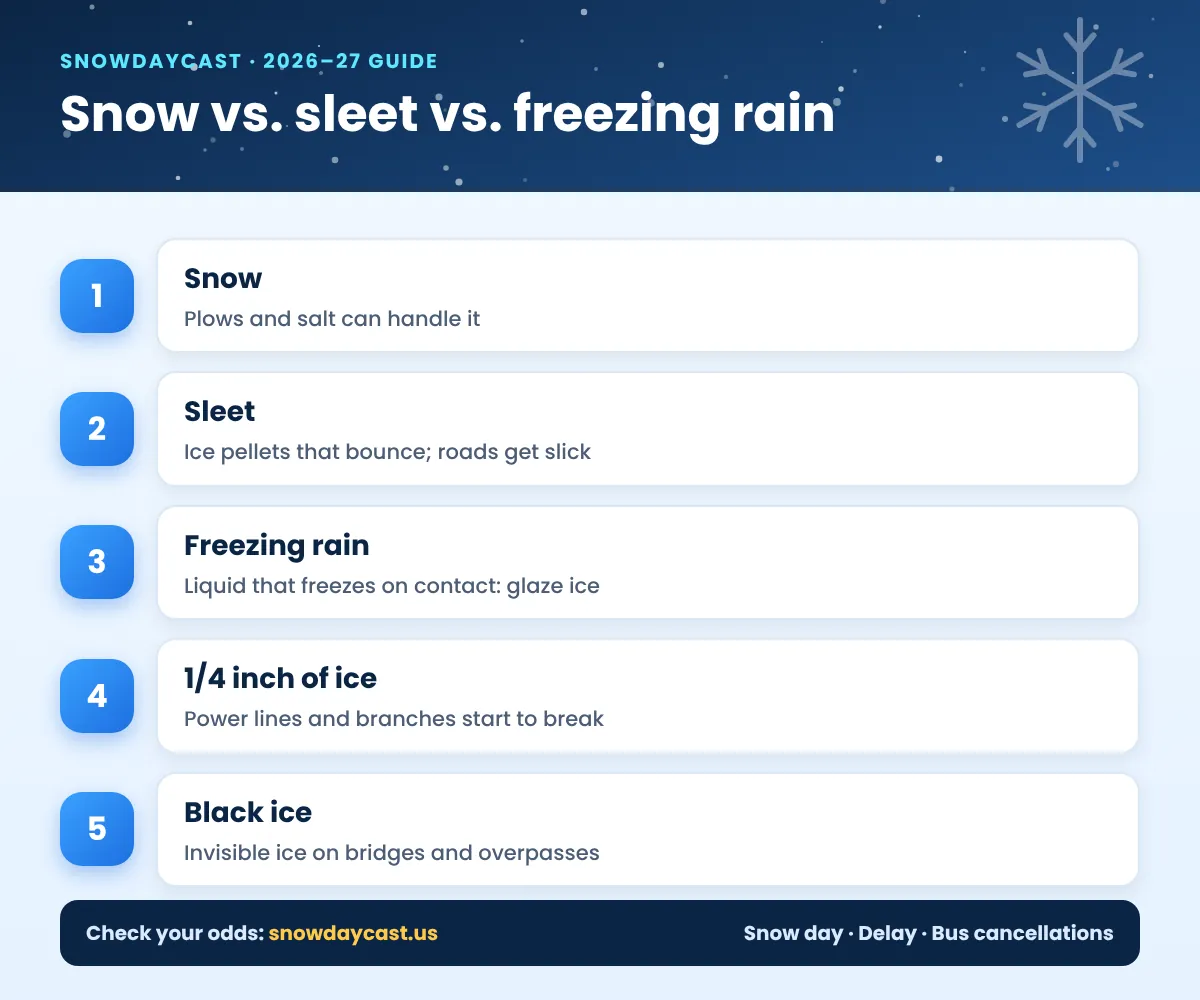
Snow, sleet and freezing rain
All three start as snow high in the clouds. What reaches the ground depends on the warm and cold layers it falls through. If a warm layer melts the snow and the air near the ground is below freezing, you get sleet (refrozen pellets) or freezing rain (liquid that freezes on contact).
| Type | What you see | School impact |
|---|---|---|
| Snow | Flakes that pile up | Depends on amount and timing |
| Sleet | Small bouncing ice pellets | Slick roads, delays likely |
| Freezing rain | Clear glaze on everything | Closures very likely |
| Black ice | Invisible thin ice | Delays and closures, especially on bridges |
Why ice is so disruptive
- Traction: buses and cars can’t stop or climb hills on glaze ice.
- Walkers: students walking or waiting at stops can slip and fall.
- Power: ice-weighted branches and lines cause outages that leave schools without heat.
- Treatment: salt works less well as temperatures fall, and freezing rain can wash it away.
Where ice storms are most common
A wide belt from Texas and Oklahoma through Arkansas, Missouri, Tennessee, Kentucky and into the Mid-Atlantic sees frequent ice storms, as do the Ottawa and St. Lawrence valleys in Canada. Check your area on our state pages or the Canada calculator.
Ice day checklist for families
- Charge phones and devices the night before.
- Keep salt or kitty litter by the door for steps and the driveway.
- Expect a delay to become a closure if freezing rain continues after 6 AM.
How much ice causes ice storm school closures?
The National Weather Service typically issues an Ice Storm Warning when about a quarter inch or more of ice is expected, the level where trees and power lines start to break. But ice storm school closures often happen with far less: a few hundredths of an inch on untreated roads, sidewalks and bus steps at 6 AM is enough for many districts to cancel. Learn how winter storms form in the NOAA severe weather guide.
Ice storm school closures can last more than one day
Snow can be plowed, but ice must melt or be broken up. If temperatures stay below freezing after an ice storm, side roads and parking lots can stay dangerous for days, and power outages can leave schools without heat. That’s why ice events often bring back-to-back closures or delays.
Ice safety tips
- Walk like a penguin: short steps, feet flat.
- Stay away from downed power lines.
- Never run a generator indoors.
Why ice storms are hard to forecast
Freezing rain depends on a thin layer of warm air above a shallow layer of cold air near the ground. A change of just one or two degrees in either layer can turn freezing rain into plain rain, sleet or snow. That’s why ice storm forecasts often come with wide ranges and last-minute updates, and why districts sometimes wait until the early-morning road check before deciding.
Ice storm school closures by region
- Southern Plains and South: ice is the most common reason schools close in winter.
- Ohio and Tennessee valleys: mixed storms often bring a period of freezing rain.
- Mid-Atlantic and Northeast: cold air trapped east of the mountains can turn rain into ice.
- Eastern Canada: Ontario and Quebec are known for long freezing-rain events.
Frequently asked questions
How much ice closes school?
Many districts close for any measurable freezing rain during the morning commute, because even a thin glaze makes roads, sidewalks and bus steps dangerous.
What is the difference between sleet and freezing rain?
Sleet is frozen before it reaches the ground and bounces as ice pellets. Freezing rain falls as liquid and freezes on contact, creating a smooth glaze that is more dangerous.
What is an Ice Storm Warning?
The National Weather Service issues an Ice Storm Warning when significant ice accumulation is expected, enough to cause dangerous travel and damage trees and power lines.
Why do southern schools close for ice so often?
Southern areas have fewer salt trucks and plows, more drivers unused to ice, and more ice events than heavy snow events.
Keep reading
 Snow Day Basics · 5 min readHow Do Schools Decide Snow Days? Inside the 5 AM CallSuperintendents usually make the snow-day call between 4:30 and 6:30 AM after checking forecasts, driving the roads and talking to transportation teams.
 Snow Day Fun · 4 min read12 Snow Day Superstitions Kids Swear By (and Why They're Fun)Wear your pajamas inside out, flush ice cubes, sleep with a spoon under your pillow: here are the most popular snow day…
 Snow Day Basics · 4 min readHow to Check if School Is Closed Tomorrow (Fast)Sign up for your district's alerts, check its website and social accounts, watch local TV closing lists, and use a snow day…