
Are snow days going away? Not completely, but many districts can now switch to remote learning instead.
Snow days are changing, not disappearing. Many districts can now switch to remote, virtual or e-learning days instead of closing, and some large systems such as New York City public schools do so routinely. But power outages, internet gaps and family needs keep traditional snow days alive in many areas.
Key takeaways
- Remote days count toward required instruction time where allowed.
- Rules differ by state, province and district.
- Widespread outages can still bring a true snow day.
How remote and e-learning days work
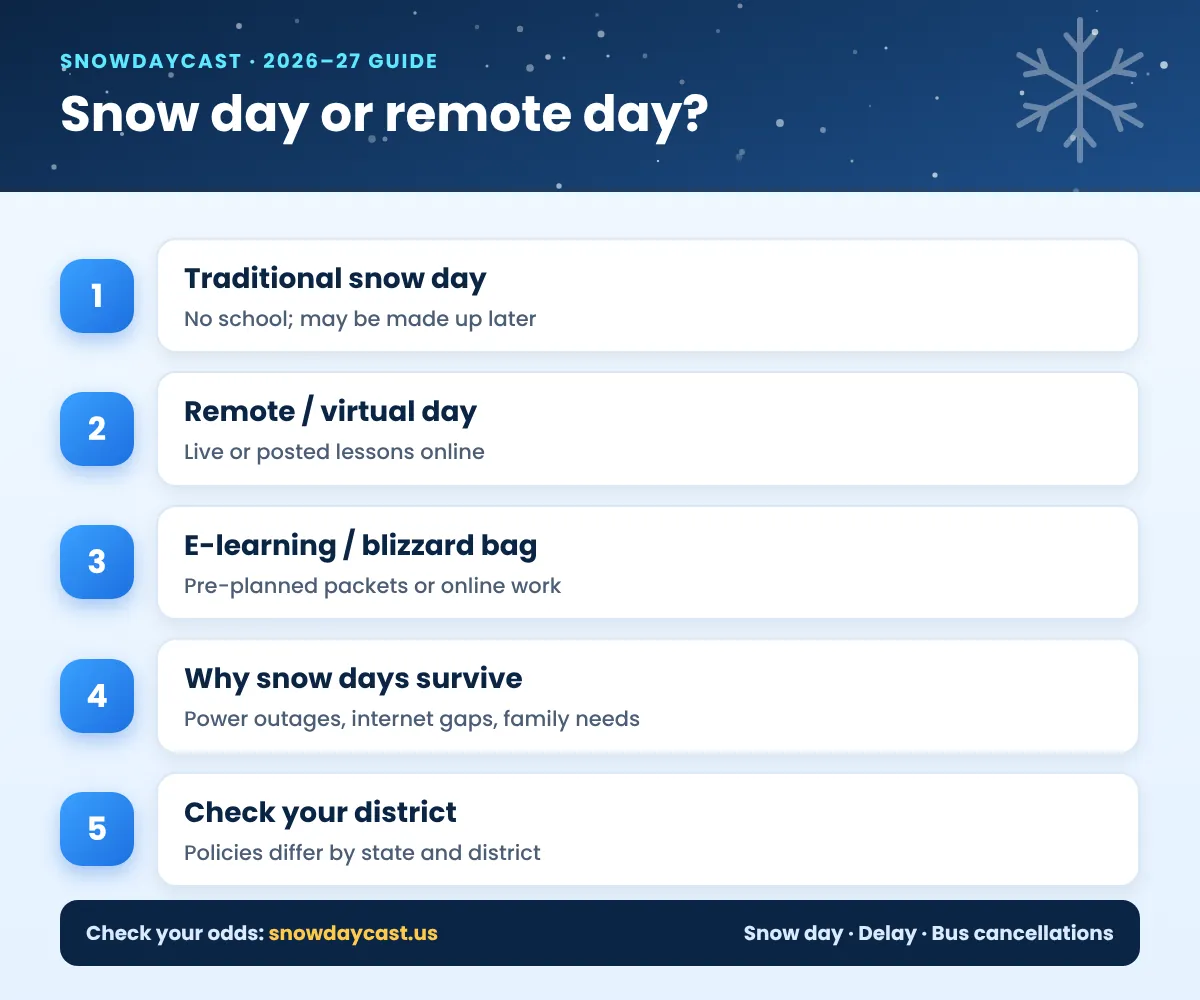
When in-person school is unsafe, districts with an approved plan post lessons online or send home work packets (sometimes called “blizzard bags”). Depending on the state, these days can count toward the required number of instructional days, so they don’t need to be made up in June.
| Approach | How it works | Common in |
|---|---|---|
| Traditional snow day | No school; made up later if needed | Many districts in the US and Canada |
| Remote / virtual day | Online classes or assignments | Large urban systems, some states |
| E-learning / blizzard bag | Pre-planned packets or online work | Parts of the Midwest and Northeast |
| Bus cancellation only | Schools open, buses don’t run | Canada and rural districts |
Why real snow days aren’t gone
- Not every family has reliable internet or devices.
- Storms can knock out power for students and teachers.
- Many states limit how many remote days count.
- Some districts simply prefer traditional snow days, which are built into the calendar.
Our snow day calculator tells you how likely it is that in-person school will be closed or delayed. Check your district’s policy to know whether that means a snow day or a remote day.
Are snow days going away for good?
Probably not. Even districts with remote-learning plans still call traditional snow days when power and internet are out, when teachers can’t prepare lessons in time, or when the state limits how many remote days count. Many families and educators also value the occasional true snow day as a break.
How to prepare for a remote snow day
- Charge laptops and tablets the night before a storm.
- Know where to find assignments and log-in details.
- Have a quiet workspace and a backup hotspot if possible.
- Ask the school what happens if your power or internet goes out.
Before any winter storm, the Ready.gov winter weather checklist helps families prepare for outages.
Remote snow days: what students should expect
On a remote day, students typically log in at set times or complete assignments posted by teachers. Attendance may be taken online. Younger students might receive activity packets instead of live classes. Schools usually explain the plan before winter, so families know what’s expected when a storm hits.
Snow days in Canada
In Canada, the more common pattern is bus cancellations while schools stay open, rather than switching to remote learning. Full closures still happen for major storms and freezing rain, and some boards have contingency plans for online learning during extended closures.
The bottom line
Snow days are evolving, but weather still decides whether in-person school is safe. Our calculator predicts that weather-driven chance; your district decides whether a closed day is a snow day or a remote day.
Frequently asked questions
Are snow days being replaced by remote learning?
In some places, yes. New York City public schools, for example, have switched to remote learning on many snow days, and several states allow e-learning or virtual days. Many districts still use traditional snow days.
What is an e-learning day?
A day when school is closed but students complete assignments online or from a packet, so the day counts toward instructional time.
Can remote days be cancelled?
Yes. If power or internet outages are widespread, districts may call a traditional snow day instead.
Does your calculator predict remote days?
Our calculator predicts the weather-driven chance that in-person school is closed or delayed. Whether that becomes a remote day depends on your district's policy.
Keep reading
 Snow Day Basics · 6 min readHow Much Snow for a Snow Day? (2027 Guide by Region)It depends on where you live: an inch can close schools in the South, while northern districts may need 6–12 inches. Here…
 Winter Travel · 5 min read12 Best National Parks to Visit in Winter (2026–27 Snow Guide)Snow-covered geysers in Yellowstone, white-capped hoodoos at Bryce Canyon, quiet Yosemite Valley: the best national parks for a winter trip and how…
 Snow Day Basics · 4 min readSnow Day vs. 2-Hour Delay vs. Early Dismissal: What's the Difference?A delay pushes the start of school back so roads can be cleared; a snow day closes school for the day; an…