
School bus cancellations are far more common in Canada than full school closures, especially in rural areas.
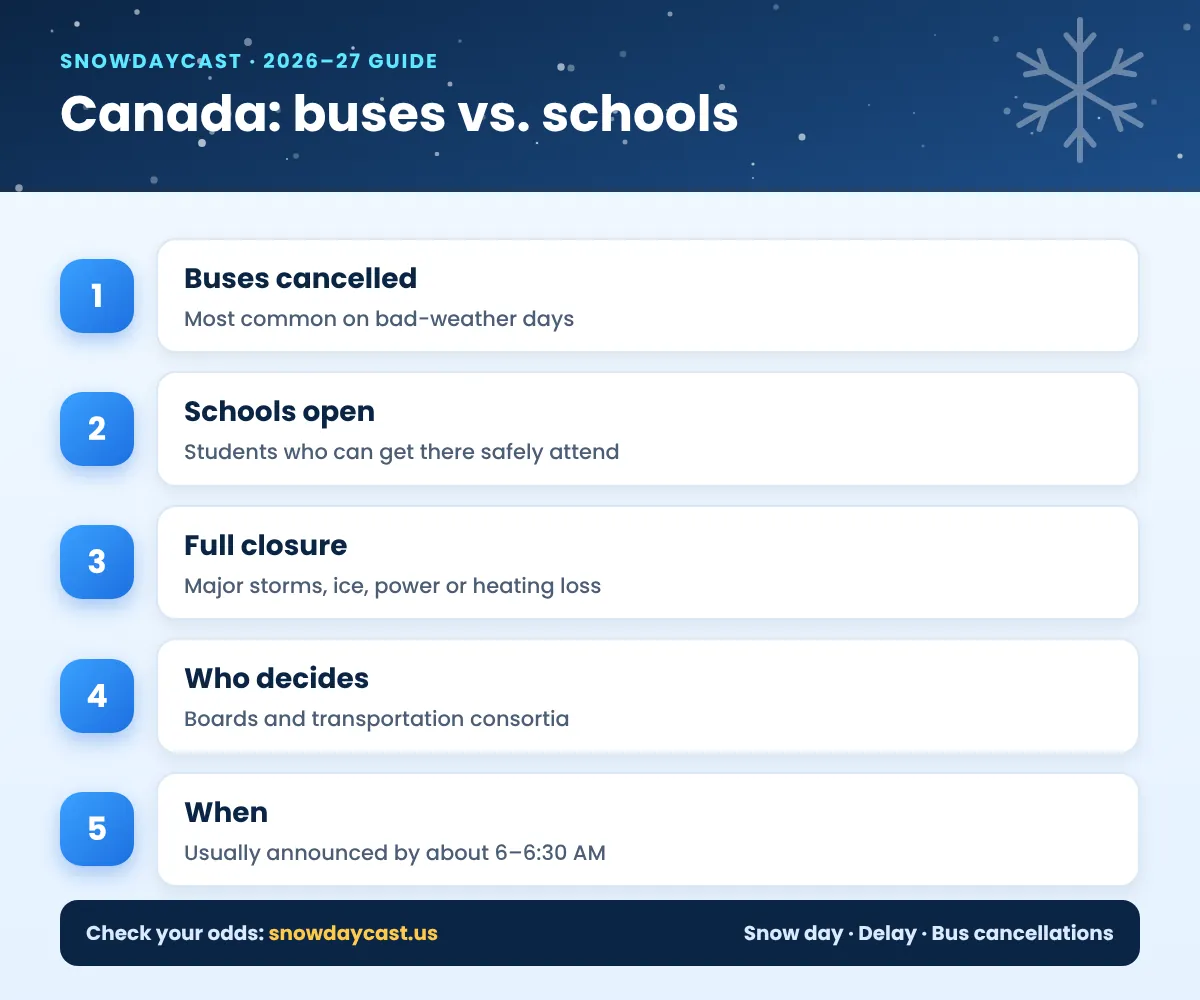
In much of Canada, buses are cancelled far more often than schools are closed. Boards keep schools open for students who can get there safely, while transportation consortia cancel buses on unsafe rural routes. Full closures usually need a major storm, freezing rain, or a power or heating failure.
Key takeaways
- Bus cancellation does not mean school is closed.
- Consortia often cancel buses by zone.
- Freezing rain is the top closure trigger in Ontario and Quebec.
- Our calculator shows bus-cancellation odds separately.
How it works by province
| Province | Typical approach |
|---|---|
| Ontario | Transportation consortia cancel buses by zone; boards decide closures |
| Quebec | School service centres close schools for major storms and verglas |
| Alberta & Saskatchewan | Urban schools stay open; rural divisions cancel buses for cold and blowing snow |
| Manitoba | Divisions cancel buses for blizzards and closed highways |
| Atlantic Canada | Regional centres close schools for nor’easters and freezing rain |
| British Columbia | Lower Mainland closes for small amounts of snow; Interior is snow-ready |
Where to check
- Your school board’s website and social accounts.
- Your regional student transportation consortium (Ontario) or division transportation page.
- Local radio and TV closing lists.
- Our Canada snow day calculator for the odds the night before.
See your province: Ontario, Quebec, Alberta, British Columbia, Nova Scotia.
What school bus cancellations mean for families
On days with school bus cancellations, schools usually stay open and staff report to work. Families who can safely drive their children may do so; students who stay home are often marked as excused, depending on the board. Report cards and tests are usually rescheduled if many students are absent.
Weather that triggers school bus cancellations
- Freezing rain or icy roads in the early morning.
- Heavy snow or blowing snow that reduces visibility on rural routes.
- Extreme cold, where boards set wind-chill limits for students at stops.
- Fog, especially in parts of Ontario and the Maritimes.
Check forecasts and warnings from Environment and Climate Change Canada the night before.
School bus cancellations by zone
Large boards often divide their area into zones. Buses may be cancelled in rural or northern zones while city routes run normally. When you check school bus cancellations, look for your zone or route number rather than a board-wide message, and sign up for alerts by zone if your consortium offers them.
Full school closures in Canada
Full closures are usually reserved for major storms, widespread freezing rain, or problems at the building such as power or heating loss. When a board closes schools, after-school programs and evening events are typically cancelled too. In Quebec, school service centres announce closures for whole regions, often early in the morning.
Frequently asked questions
Why do Canadian schools stay open when buses are cancelled?
Boards keep schools open for students who live close or can be driven safely, while cancelling buses that run long rural routes in unsafe conditions.
Who cancels school buses in Ontario?
In Ontario, regional student transportation consortia usually cancel buses by zone, while school boards decide on full closures.
Do Canadian schools close for snow?
Full closures are less common than bus cancellations, but they happen for major storms, freezing rain, and power or heating failures.
Does your calculator predict bus cancellations?
Yes. Each prediction shows the chance of buses being cancelled alongside the chance of a full closure and a delayed start.
Keep reading
 Snow Day Basics · 4 min readAre Snow Days Going Away? Remote Learning Days ExplainedMany districts now switch to remote or e-learning days instead of traditional snow days, but power, internet and teacher-planning limits keep real…
 Snow Day Basics · 4 min readHow Accurate Is a Snow Day Calculator? How Ours WorksA snow day calculator estimates odds from forecasts. It's most reliable the evening before a storm and least reliable several days out.…
 Snow Day Fun · 4 min read40 Snow Day Activities for Kids (Indoor & Outdoor)From snow ice cream and colored snow painting to indoor forts and science experiments, here are 40 easy ways to make a…