
Snow day calculator accuracy depends on the forecast, the timing of the storm and how closely your district follows typical patterns.
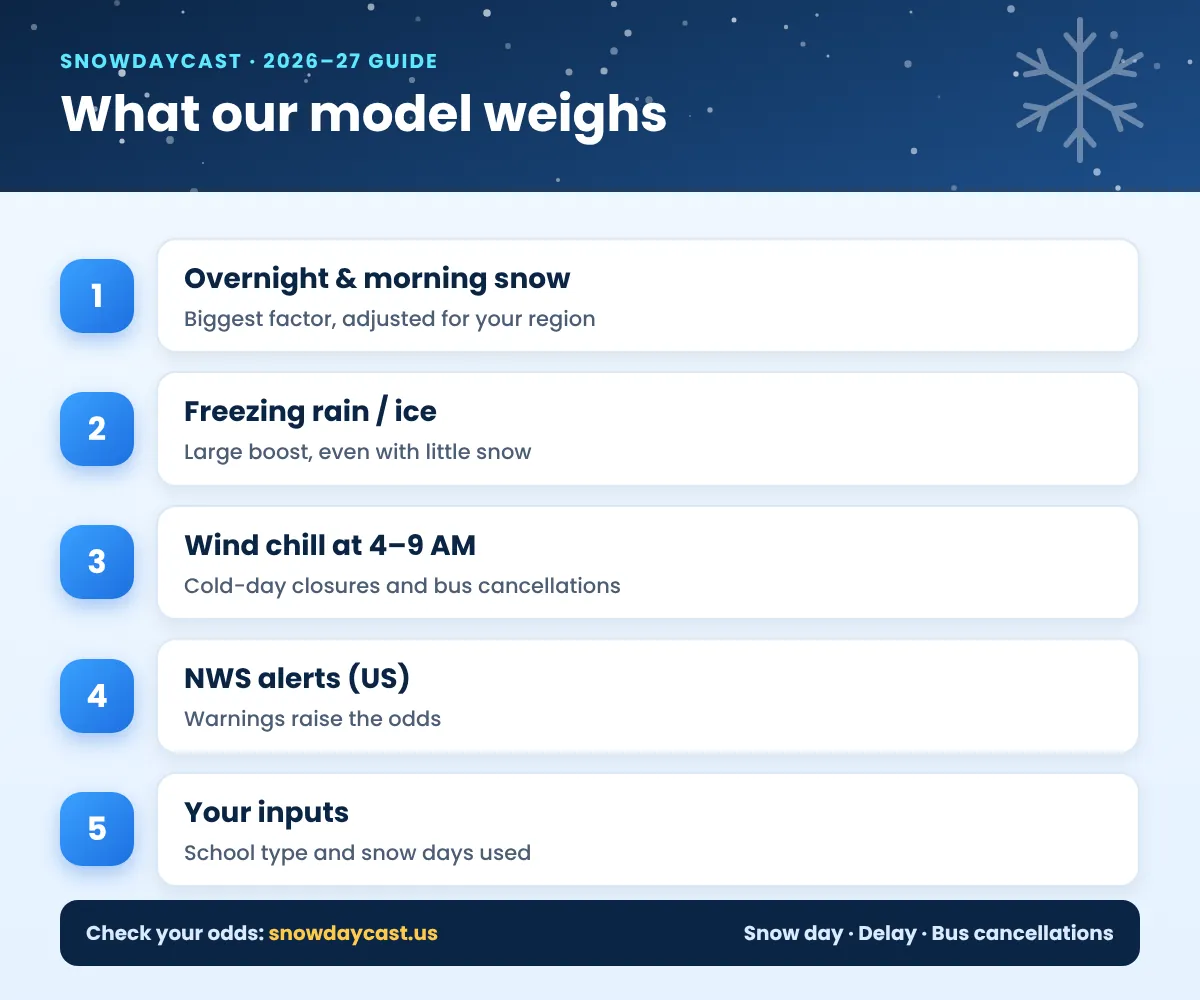
A snow day calculator is an estimate, not an announcement. It’s most useful the evening before a storm, when forecasts are most reliable. SnowdayCast weighs overnight and early-morning snow, ice, wind chill, wind and National Weather Service alerts, and adjusts for how used to snow your area is.
Key takeaways
- Odds are best the evening before.
- Ice and timing can matter more than totals.
- Your area’s snow tolerance changes the threshold.
- Always confirm with your district.
How the SnowdayCast model works
- Find your location from a ZIP code, postal code, city or your device’s location.
- Pull the hourly forecast for that exact point.
- Focus on the school-morning window: snow from 6 PM the evening before to 9 AM, plus earlier snow that may still be on roads.
- Adjust for your region: areas that rarely see snow close for less.
- Add ice, wind chill and wind: freezing rain and dangerous cold raise the odds sharply.
- Add official alerts: in the US, active NWS warnings and advisories are included.
- Show three answers: chances of a full closure, a delayed start and bus cancellations.
When predictions are most and least reliable
| Time before school | Reliability |
|---|---|
| Evening before | Good: storm timing usually clear |
| Early morning | Best: the storm is underway |
| 2–3 days out | Fair: amounts and timing can shift |
| 4+ days out | Low: treat as a heads-up only |
Read the full methodology, or try the manual snow day calculator to see how each factor changes the odds.
How to improve snow day calculator accuracy for your school
- Check the prediction the evening before, then again around 5 AM.
- Look at the factors, not only the percentage: ice or a sudden morning burst of snow changes everything.
- Compare tomorrow with the next school day; storms often affect two mornings.
- Remember your district’s habits: some close easily, others almost never.
Where our predictions get their data
Hourly forecasts come from Open-Meteo, and US alerts come directly from the National Weather Service. Canadian users can compare with official warnings from Environment and Climate Change Canada.
Why two calculators can disagree
Different sites use different forecast models, time windows and thresholds. Some only look at total daily snowfall; others, like ours, focus on the overnight and early-morning window and add ice, wind chill and alerts. Neither is “right” until the district decides, but a model that explains its factors helps you judge the result.
Known limits
- Narrow lake-effect bands can be missed by a few miles.
- Rain-snow lines can shift late, changing totals quickly.
- District policies (remote days, snow days already used) vary widely.
- Unexpected events such as power outages or water main breaks aren’t weather-driven.
We review our model before each season and welcome feedback through our contact page.
Frequently asked questions
Are snow day calculators accurate?
They are estimates. Accuracy is best the evening before a storm, when forecasts are most reliable, and depends on how closely your district follows typical patterns.
What data does SnowdayCast use?
Hourly forecasts from Open-Meteo (snowfall, freezing rain, temperature, wind chill and gusts) and, in the US, active National Weather Service alerts for your exact location.
Why does my prediction change?
Forecasts update through the day. When snowfall amounts or timing shift, your odds change too. Check again in the evening and early morning.
Can a calculator know my district's decision?
No. Only your district or school board can close school. We estimate how likely that decision is based on the weather.
Keep reading
 Winter Weather · 4 min readWhy Ice Closes Schools Faster Than Snow: Ice Storm Guide 2027Freezing rain coats roads, sidewalks and power lines in a glaze that plows can't push away, so schools often close for ice…
 Winter Travel · 5 min read12 Best National Parks to Visit in Winter (2026–27 Snow Guide)Snow-covered geysers in Yellowstone, white-capped hoodoos at Bryce Canyon, quiet Yosemite Valley: the best national parks for a winter trip and how…
 Snow Day Basics · 6 min readHow Much Snow for a Snow Day? (2027 Guide by Region)It depends on where you live: an inch can close schools in the South, while northern districts may need 6–12 inches. Here…