
Wind chill school closures happen when the cold at bus-stop time is dangerous for students, even if no snow is falling.
Schools close for cold when the wind chill at bus-stop time is dangerous for students. There is no single national rule: many northern US districts act somewhere around -20°F to -35°F wind chill, southern districts act at much milder cold, and Canadian boards often cancel buses rather than close schools.
Key takeaways
- Wind chill, not air temperature, drives the decision.
- The bus-stop wait is the biggest risk.
- Northern districts tolerate far more cold than southern ones.
- Our calculator includes morning wind chill in every prediction.
Wind chill and frostbite
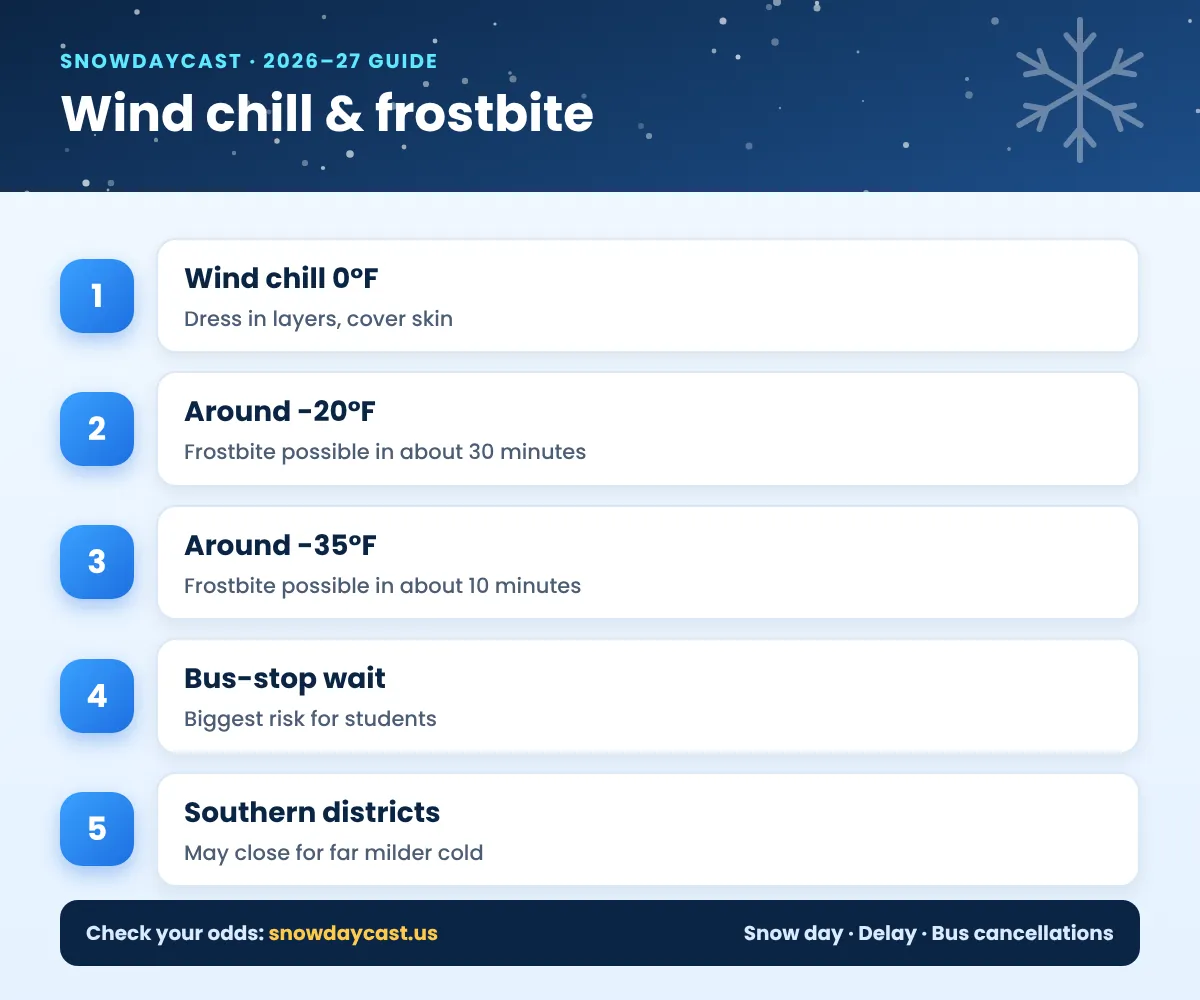
The National Weather Service wind chill chart shows how quickly exposed skin can freeze. As wind chills drop below about -20°F, frostbite can set in within half an hour; near -35°F, it can happen in around 10 minutes. That’s why districts focus on the coldest stretch of the morning, when students are walking or waiting for buses.
| Region | Typical approach to cold |
|---|---|
| Upper Midwest, northern Plains | Delays or closures for extreme wind chills |
| Great Lakes, New England | Delays common; closures for severe cold |
| Mid-Atlantic, Ohio Valley | Delays for unusual cold, especially with ice |
| South | Rare hard freezes can close or delay school |
| Canada | Schools open; buses cancelled at set wind-chill limits |
Cold-weather alerts to watch
The National Weather Service issues Cold Weather Advisories and Extreme Cold Warnings (which replaced the older wind chill products). When an Extreme Cold Warning covers the morning, our snow day calculator raises the closure and bus-cancellation odds.
Keeping kids safe at the bus stop
- Layer up: hat, mittens, scarf or neck gaiter, insulated boots.
- Cover every bit of skin on the coldest mornings.
- Wait inside until the bus is close if you can track it.
- Know the signs of frostbite: numbness, and white or grayish skin.
How wind chill school closures are decided
Districts that use wind chill school closures usually look at the forecast wind chill between about 6 and 8 AM, when students wait for buses or walk to school. Many compare it with the NWS wind chill chart to judge frostbite risk. Some districts publish a set threshold; others decide case by case. When an Extreme Cold Warning covers the morning, closures and late starts become much more likely.
What to wear on wind chill days
- A base layer, a warm middle layer and a windproof coat.
- Hat covering the ears, neck gaiter or scarf over the face.
- Insulated waterproof boots and mittens (warmer than gloves).
- Extra dry socks and mittens in the backpack.
The CDC winter weather safety page lists signs of frostbite and hypothermia every parent should know.
Air temperature vs. wind chill
Air temperature is what a thermometer reads. Wind chill is how cold it feels on bare skin when wind carries heat away from the body. On a 0°F morning, a 15 mph wind makes it feel well below zero, and frostbite comes much faster. That’s why wind chill school closures focus on wind chill rather than temperature alone.
Wind chill school closures in Canada
Canadian schools usually stay open in extreme cold, but school boards and transportation consortia often cancel buses when wind chill reaches a set limit. Families who drive their children can still send them to school. Check your board’s announcements early on very cold mornings.
Indoor recess and cold days
Even when school is open, many schools hold indoor recess when the wind chill is low. Send kids with warm gear anyway, since they may walk between buildings or wait outside at dismissal.
Frequently asked questions
How cold does it have to be to cancel school?
There's no national rule. Many northern districts consider closing or delaying when wind chills are expected around -20°F to -35°F at bus-stop time, while southern districts may act at much milder temperatures.
What is wind chill?
Wind chill is how cold it feels on exposed skin when wind is combined with low temperature. It's what drives frostbite risk.
How fast can frostbite happen?
According to the National Weather Service wind chill chart, frostbite can happen in about 30 minutes at -20°F wind chill and about 10 minutes near -35°F.
Do Canadian schools close for cold?
Canadian schools usually stay open, but buses are often cancelled when wind chill reaches a set limit, especially in rural areas.
Keep reading
 Snow Day Basics · 4 min readHow to Check if School Is Closed Tomorrow (Fast)Sign up for your district's alerts, check its website and social accounts, watch local TV closing lists, and use a snow day…
 Snow Day Fun · 4 min read12 Snow Day Superstitions Kids Swear By (and Why They're Fun)Wear your pajamas inside out, flush ice cubes, sleep with a spoon under your pillow: here are the most popular snow day…
 Winter Weather · 4 min readWhy Ice Closes Schools Faster Than Snow: Ice Storm Guide 2027Freezing rain coats roads, sidewalks and power lines in a glaze that plows can't push away, so schools often close for ice…